


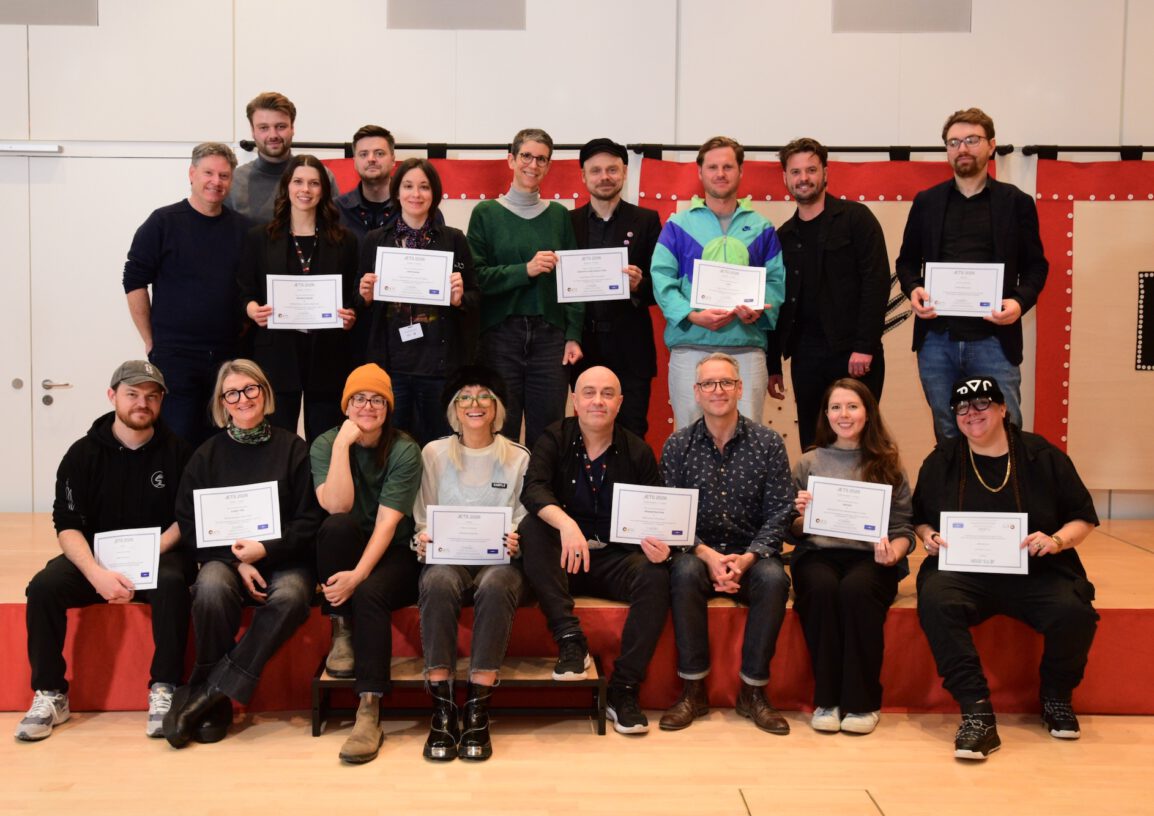
‘As a film composer, you have control over how a scene is perceived,’ said Rachel Portman, going on to explain, ‘You can make it exciting or frightening. Sad or happy. For me, the most exciting combination is when a composition expresses both happiness and tragedy.’ This diversity is precisely what makes the British Oscar winner’s soundtracks so distinctive. For over a decade, the JETS INITIATIVE honours eligible film projects from various countries. In 2026, for the first time, the initiative has also awarded film composers. On the first and second day of the event, the music/sound designers presented themselves and their work at the Bremen State Representation and Canadian Embassy Berlin. The jury presented certificates to the best entries at the Canadian Embassy on Potsdamer Platz.
Before we announce the winners of the film projects, here are the winners among the composers. Two Canadian musicians were honoured. One is Alexandra Petkovski, a multi-instrumentalist who performs under the name FJØRA. She caused a sensation in 2020 with the terrifying sounds she created for the Amazon horror series Welcome to the Blumhouse. The other is Cree cellist Cris Derksen. Her innovative blend of classical elements and traditional indigenous music has been featured in documentaries such as ‘People of a Feather’ (2011), miniseries such as ‘8th Fire’ (2012), and feature films such as ‘The Well’ (2025).
Two German artists also received awards: 29-year-old Peter Albrecht, who, like the author of this article, is from Frankfurt am Main, has already composed a large number of pieces. His works include Chiara Fleischhacker’s feature film Vena (2024), Douglas Wolfsperger’s cinema documentary Denn dieses Leben lebst nur du (2025), and Constantin Schreiber’s television documentary Israel nach dem 7. Oktober – Reise durch ein zerrissenes Land’ (2025). Born in Herzberg am Harz in 1994, Steffen Brinkmann initially composed music for low-budget films. As no symphony orchestra could afford to provide the musical accompaniment, his orchestral music was mostly simulated digitally. As well as film music (Orang-Utans – Borneo’s Forest People) and classical music (Bergmannsrhapsodie, 2016), he also writes video game music (Harry Potter: Magic Awakened, 2022).
In Ireland, the jury could only agree on one winner. Daithí (whose full name is Daithí Ó Drónai) is a young violinist. He rose to fame after appearing in the first series of the talent show Must Be the Music on the Sky 1 channel in 2011, reaching the final. Daithí is renowned for his distinctive style of live electronic music. His performances are based on house music and incorporate synthesizers, the Ableton Live computer programme and a synthetic violin. Each ‘track’ is improvised, broken down into small loops and mixed differently at each show. Film compositions: Lakelands (2022), Croí (2022) and Yellow Belt (2023).
And now, please welcome the winners of the film projects: The Australian entry is particularly touching. In Luna, pitched by producer brothers Henry and Hugo Koehne, eight-year-old Luna mishears her father’s brain tumour as ‘brain tuna’ instead of ‘brain tumour’. She imagines how she can travel into his head and fish it out. But one day, she learns to face the sad truth. This is a fairy-tale-like yet serious family drama about saying goodbye that will affect and move everyone.
Canada has two winners: The Night Maere, directed by Michael Peers and produced by Yasmine Majchrzak, is about a supernatural entity that preys on people experiencing sleep paralysis. Painter Maria endures this nightmarish experience after giving up her career for her fiancé Eoin, only to find herself working as a housekeeper in a newly renovated coastal home. Although Maria is deeply frightened by the witch-like creature, she realises that the real danger comes from the house itself. The combination of mythological horror and criticism of civilisation makes the project even more exciting.
White Noise, directed by Tamara Scherbak and produced by Christina Saliba, is a psychological thriller that tells the story of art conservator Ava, who suffers physically and psychologically from an allergy to noise. When she is commissioned to restore a painting by Artemisia Gentileschi in a soundproof room, strange events begin to occur around and within her. Despite all the suspense, the film also encourages us to embrace silence in our increasingly hectic world.
Hearing loss is also the subject of Karlotta & the Scarlet Viper, the German winner directed by Juliane Block and produced by Wolf-Peter Arand. The nine-year-old protagonist wears a cochlear implant. She copes with her condition by imagining that she is the fearless pirate captain Lotta LeRoux, who doesn’t need any help. However, she becomes dependent on others when she loses her hearing aid during a summer holiday with her grandmother. True strength lies not in coping with everything alone, but in trusting the people you love and accepting their support when you need it.
Ireland presents A Quiet Tide, a historical drama directed by Martina McGlynn and produced by Garret Daly. The film is about the botanist Ellen Hutchins (1775–1815). Hutchins identified hundreds of new plant species and became renowned for her botanical illustrations in contemporary publications. Several plants were named after her. She is widely regarded as Ireland’s first botanist. The film begins a year before her death, when she sets out on the coast of West Cork in search of a rare flower, despite her poor health. It is both a naturalistic adventure and a portrait of a strong woman who never gave up despite all the difficulties she faced.
In the United Kingdom of Great Britain and Northern Ireland, Arkadia, directed by Rebekah Fortune and produced by Hannah Eugénie Tookey, was honoured as a promising sci-fi horror thriller. Cassie Arkwright is the face of a utopian city whose aim is to keep its workers healthy, happy and productive. As a child, she received a revolutionary implant that restored her eyesight. She is now pregnant, and everything in her medical dynasty could not be going better. However, after a traumatic birth in which she loses her baby, her seemingly perfect life begins to fall apart. In hospital, she suddenly sees a Victorian nurse stealing children. Her family is also behaving strangely. Could her baby be alive after all? She gradually uncovers the dark secret of Arkadia. Things also take a dark turn in Reconstruction by director Matt Harlock and producer Dan Dixon. Cassie Rourke, producer of a TV show re-enacting unsolved murder cases, is contacted by one of the killers. She makes the fatal mistake of reporting on it on the show. The ratings skyrocket, but when she tries to unmask the perpetrator, he reveals his true motive and publicly exposes a secret that Cassie has skilfully concealed for years. Inspiration for this nerve-racking thriller with surprising twists and turns came from films such as The Silence of the Lambs (1991), The Girl with the Dragon Tattoo (2011) and Nightcrawler (2014). The JETS INITIATIVE once again offered a wide spectrum of up-and-coming filmmakers, whether they specialised in suspense, sound or sensation!
Marc Hairapetian is a freelance journalist (working for publications including Frankfurter Rundschau, Berliner Zeitung and Die junge Welt) and, since the age of 16, editor of the cultural magazine Spirit – Ein Lächeln im Sturm (A Smile in the Storm), which he founded. https://spirit-fanzine.de